D2Audio D2-81431
D2Audio was a fabless semiconductor company founded around 2002 with a singular focus: closing the feedback loop on Class D amplification in the digital domain. Traditional Class D designs modulate an analog input into PWM, amplify it, and filter it back to analog — a process that introduces distortion at every stage boundary. D2Audio’s approach kept the signal digital from input to output stage, running adaptive correction algorithms against the actual PWM waveform and speaker current in real time. Intersil acquired D2Audio in 2009 for the IP portfolio. Renesas acquired Intersil in 2017. The D2-1 product family is now listed as Not Recommended for New Designs, which is the semiconductor industry’s way of saying the parts are still available but the engineering support is gone.
The D2-81431 is a member of the D2-1 family alongside the D2-81412, D2-81433, D2-81434, and D2-81435. It comes in a 128-pin LQFP package and runs its core logic at 1.7V to 1.9V. The part integrates a four-channel DSP with PWM controller, sample-rate converter, and a full suite of audio processing: parametric EQ, tone control, volume with soft ramp, dynamic range compression, crossover filters, and power limiting. It accepts up to four channels of I2S or left-justified digital audio at 16 to 24 bits, 32 to 192 kHz sample rates, with an optional S/PDIF input. Published specifications claim better than 110 dB signal-to-noise ratio and less than 0.1% THD+N across the audio band.
The distinguishing feature of the D2-1 architecture is the adaptive digital feedback system. The DSP monitors both the PWM output voltage and the speaker return current through dedicated sense inputs, then applies correction on a cycle-by-cycle basis. This is not a simple open-loop design where you set coefficients and hope the output stage behaves — the DSP actively measures what is actually happening at the speaker terminals and adjusts its modulation to compensate for power supply droop, thermal drift in the MOSFETs, and nonlinearity in the output filter. D2Audio’s published application data shows this feedback loop pulling measured THD+N down to approximately 0.05% under load, a substantial improvement over the raw open-loop figure.
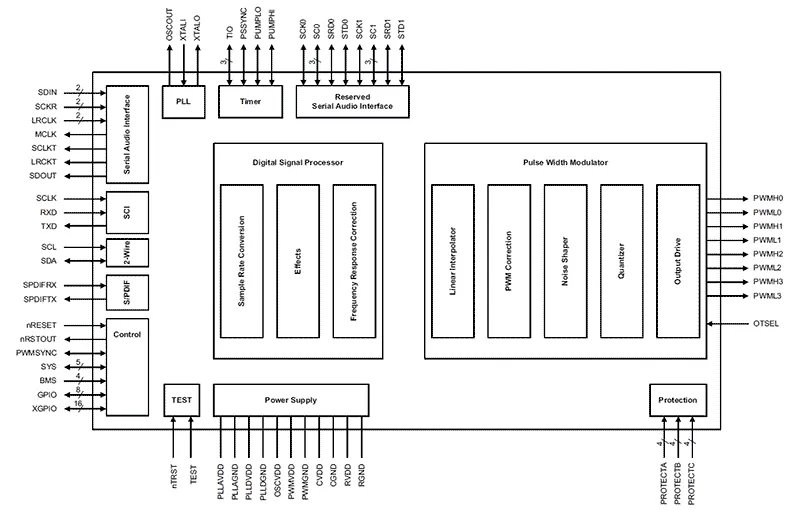
The D2-81431 has no internal non-volatile memory. It boots entirely from an external I2C EEPROM connected through a dedicated bus on GPIO6 and GPIO7. This NVM bus is separate from the host control I2C interface (SCL/SDA) that the system controller uses for runtime parameter writes. At power-on, the boot mode is set by the state of the IRQ[D:A] pins: when IRQ[D:A] equals 0001, the chip self-boots from the EEPROM, reading its firmware image, DSP coefficient tables, filter topologies, and protection thresholds autonomously. When IRQ[D:A] equals 0000, the chip enters I2C slave mode and waits for an external microcontroller to feed it a bootloader image at address 0x88 — this is the firmware update path.
During normal operation, the host MCU communicates with the D2-81431 at I2C address 0xB2. Writes to this address modify runtime parameters: volume level, EQ coefficients, crossover frequency, phase offset, compression thresholds. The D2-81431 applies these changes in real time without interrupting audio output.
The OEM development environment for the D2-1 family was a Windows application called “Audio Canvas,” also referred to as the “D2 Audio Customization GUI v3.” This tool allowed licensed OEMs to design filter topologies, set protection parameters, tune DSP coefficients, and generate the binary images that get burned into the EEPROM. It was never a public tool — D2Audio, and later Intersil and Renesas, distributed it only to customers with volume purchase agreements. The firmware images it produces are proprietary binary blobs specific to each OEM’s amplifier design. There is no generic “D2-81431 firmware” — every product that uses this chip has its own custom image built from the OEM’s Audio Canvas project.